



Remote Surgery (Telesurgery): The Future of Advanced Surgical Care
Modern healthcare is rapidly evolving with the help of robotics, artificial intelligence, and digital communication technologies. One of the most revolutionary advancements in this field is Remote Surgery, also known as Telesurgery. This advanced surgical technique allows surgeons to perform operations on patients from a distant location using robotic systems, high-speed internet, and real-time video communication.
At Tieten Medicity Hospital, advanced surgical care and modern minimally invasive procedures are led by experienced specialists like Dr. Pradeep Tripathi, who focuses on patient safety, precision surgery, and modern treatment approaches.
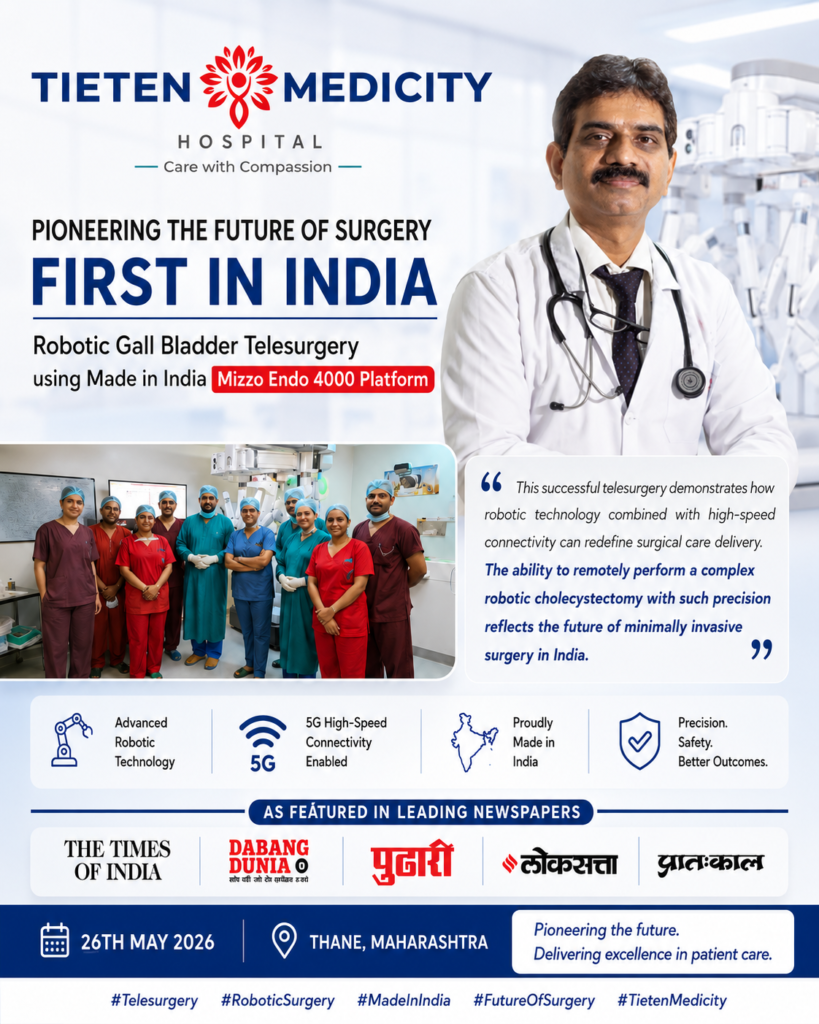
What is Remote Surgery (Telesurgery)?
Remote surgery or telesurgery is a form of robotic-assisted surgery where the surgeon and patient are located in different geographical locations. The surgeon controls robotic surgical instruments through a computerized console connected via high-speed communication networks.
The term “telesurgery” originates from:
- Tele = Distance or remote
- Cheir = Hand
- Ergein = To work
In simple words, telesurgery means performing surgery from a distance using robotic hands controlled by a surgeon.
This technology combines:
- Robotic surgery
- Artificial intelligence
- High-speed internet
- Real-time imaging
- Precision instruments
- Advanced communication systems
The primary goal of telesurgery is to provide expert surgical care to patients regardless of location.
Evolution of Remote Surgery
The world’s first successful telesurgery was performed on September 7, 2001, known as the “Lindbergh Operation.”
During this milestone procedure:
- A surgeon located in New York operated on a patient in Strasbourg, France
- The surgery performed was a laparoscopic gallbladder removal (cholecystectomy)
- The operation lasted approximately 54 minutes
- No complications occurred
This historic achievement demonstrated that surgeons could safely perform operations across continents using robotic systems.
Since then, robotic-assisted surgery has advanced tremendously, improving:
- Surgical precision
- Internet latency
- Video quality
- Safety systems
- Instrument flexibility
- Surgeon control
How Does Telesurgery Work?
Remote surgery involves several advanced technological systems working together simultaneously.
-
Surgeon Console
The surgeon sits at a robotic control console equipped with:
- High-definition 3D screens
- Hand controllers
- Motion sensors
- Foot pedals
- Magnification systems
The surgeon’s hand movements are translated into microscopic robotic movements inside the patient’s body.
-
Robotic Arms
The robotic system contains multiple robotic arms that perform surgical actions with extreme precision.
These robotic arms can:
- Rotate beyond human wrist capability
- Filter natural hand tremors
- Perform delicate movements
- Operate in tiny spaces inside the body
-
High-Speed Communication Network
A stable and ultra-fast internet connection is critical in telesurgery because every movement must be transmitted instantly.
Even a slight delay (latency) can affect:
- Surgical precision
- Patient safety
- Operation time
This is why advanced fiber-optic networks and 5G technologies are becoming essential in future telesurgical procedures.
-
High-Resolution Imaging
Modern telesurgery systems use:
- 3D HD cameras
- Endoscopic imaging
- Magnified surgical views
- Real-time visualization
This allows surgeons to view internal organs with exceptional clarity.
-
Haptic Feedback Technology
One challenge in robotic surgery is the lack of direct touch sensation. Haptic feedback systems solve this problem by allowing surgeons to “feel” tissue resistance remotely.
This technology helps surgeons detect:
- Tissue texture
- Pressure
- Organ depth
- Tensile strength
Role of Robotic Surgery in Modern Healthcare
Robotic surgery has transformed modern surgical procedures by improving accuracy and minimizing trauma to the patient.
Benefits include:
- Smaller incisions
- Reduced blood loss
- Less postoperative pain
- Faster recovery
- Shorter hospital stay
- Lower infection risk
- Improved cosmetic results
Experienced surgeons such as Dr. Pradeep Tripathi use minimally invasive surgical principles to improve patient outcomes and recovery times.
Advantages of Remote Surgery
-
Access to Expert Surgeons Anywhere
One of the biggest advantages of telesurgery is that patients in remote or underserved regions can access expert surgeons without traveling long distances.
This is particularly useful in:
- Rural areas
- Military zones
- Disaster regions
- Remote islands
- Space missions
- Offshore facilities
-
Faster Emergency Care
In emergencies where specialist surgeons are unavailable locally, telesurgery can provide immediate intervention.
This may significantly improve survival rates in:
- Trauma cases
- Internal bleeding
- Organ injuries
- Battlefield emergencies
-
Improved Surgical Precision
Robotic systems eliminate natural hand tremors and allow extremely precise movements.
This helps reduce damage to surrounding healthy tissues during surgery.
-
Better Collaboration Among Surgeons
Multiple surgeons located in different cities or countries can collaborate during a single operation in real time.
This enables:
- Expert consultation
- Surgical mentoring
- Complex procedure planning
- Training opportunities
-
Reduced Infection Risk
Since fewer personnel are physically present around the patient, the risk of contamination and infection transmission can decrease.
The COVID-19 pandemic highlighted the importance of remote medical technologies in minimizing exposure risks.
Common Procedures Performed Using Robotic Surgery
Robotic and telesurgical systems are increasingly used for:
- Gallbladder surgery
- Hernia repair
- Colorectal surgery
- Urological surgery
- Gynecological surgery
- Cardiac surgery
- Bariatric surgery
- Cancer surgery
- Gastrointestinal procedures
Minimally invasive procedures performed by surgeons like Dr. Pradeep Tripathi help patients recover faster with less pain and smaller scars.
Challenges and Limitations of Telesurgery
Despite its promising future, telesurgery still faces several challenges.
-
Internet Connectivity Issues
Remote surgery requires ultra-fast and stable internet connections. Any interruption may create serious surgical risks.
Problems include:
- Latency
- Signal interruptions
- Data transmission errors
-
High Costs
Robotic surgical systems are extremely expensive.
Costs include:
- Robotic equipment
- Software maintenance
- Infrastructure setup
- Staff training
- Network systems
This makes telesurgery difficult to implement in many developing regions.
-
Cybersecurity Risks
Since patient data and surgical controls are transmitted digitally, cybersecurity becomes critically important.
Potential threats include:
- Hacking
- Data breaches
- Unauthorized access
- System manipulation
Strong encryption and secure medical networks are essential.
-
Legal and Ethical Concerns
Telesurgery raises several legal questions:
- Who is legally responsible during complications?
- Which country’s medical laws apply?
- How is patient consent obtained?
- How are technical failures handled?
Clear international regulations are still evolving.
-
Health Inequality
Advanced robotic healthcare may not be accessible to economically weaker populations.
Limited access to:
- Internet
- Digital healthcare
- Advanced hospitals
- Technology literacy
can widen healthcare inequality.
The Da Vinci Surgical System
One of the most advanced robotic surgery systems currently available is the da Vinci Surgical System by Intuitive Surgical.
Key features include:
- 3D HD visualization
- Robotic precision
- Tremor filtration
- Enhanced dexterity
- Minimally invasive techniques
The surgeon operates from a console while robotic arms perform the procedure with microscopic precision.
Future of Telesurgery
The future of remote surgery looks highly promising with the development of:
- 5G communication
- Artificial intelligence
- Machine learning
- Faster robotic systems
- Improved cybersecurity
- Advanced haptic technologies
In the coming years, telesurgery may become a routine option for:
- Rural healthcare
- Emergency trauma care
- International medical collaboration
- Space exploration missions
Remote Surgery in India
India is rapidly adopting robotic-assisted surgical technologies in major metropolitan hospitals.
The increasing use of:
- Digital healthcare
- Telemedicine
- AI-assisted diagnosis
- Robotic systems
is transforming patient care across the country.
Hospitals focusing on modern surgical excellence, including Tieten Medicity Hospital, continue emphasizing advanced minimally invasive approaches for safer surgical outcomes.
Why Patients Prefer Minimally Invasive and Robotic Surgery
Patients increasingly prefer robotic-assisted surgeries because they offer:
- Smaller scars
- Faster healing
- Less pain
- Reduced bleeding
- Lower infection risk
- Shorter hospital stays
- Quicker return to daily activities
These advantages significantly improve patient comfort and recovery experience.
Conclusion
Remote surgery or telesurgery represents one of the most remarkable innovations in modern medicine. By combining robotic technology, real-time communication, and advanced imaging systems, surgeons can now perform highly precise procedures across vast distances.
Although challenges such as cybersecurity, internet reliability, and affordability still exist, ongoing technological advancements continue to improve the safety and accessibility of telesurgery.
As robotic and digital healthcare technologies continue to evolve, the future of surgery will become increasingly precise, minimally invasive, and globally accessible.
For advanced surgical consultation and minimally invasive treatment options, patients can consult experienced specialists like Dr. Pradeep Tripathi at Tieten Medicity Hospital, Thane.
