



Early Symptoms of Hernia You Should Not Ignore | Tieten Medicity Hospital, Thane
Have you ever felt a strange bulge in your abdomen or groin after lifting something heavy — and then ignored it? You are not alone. Many people across Thane and Mumbai brush off the early warning signs of a hernia, assuming the discomfort will go away on its own. Unfortunately, it will not.
A hernia occurs when an internal organ or fatty tissue pushes through a weak spot in the surrounding muscle or connective tissue wall. While it may start with mild, easy-to-ignore symptoms, a hernia can quickly progress into a serious — sometimes life-threatening — emergency if left untreated.
At Tieten Medicity Super Specialty Hospital, Thane, our expert hernia surgeon Dr. Pradeep Tripathi has over 30 years of surgical experience and has successfully performed more than 25,000 general surgeries and 15,000 laparoscopic surgeries. In this guide, Dr. Tripathi shares the key early symptoms of hernia you should never ignore, and when to seek timely medical care.
What Is a Hernia?
A hernia develops when there is a weakness or opening in the muscular wall that normally keeps your abdominal organs in place. Through this gap, internal tissue — usually a section of the intestine or fatty tissue — can bulge outward.
Hernias are more common than most people realise. They can affect men, women, and even children. The most common types include:
- Inguinal hernia – in the groin area; more common in men
- Umbilical hernia – near the belly button; seen in both adults and children
- Hiatal hernia – part of the stomach slides up into the chest through the diaphragm
- Incisional hernia – develops at the site of a previous surgical incision
- Femoral hernia – in the upper thigh or groin; more common in women
The key thing to understand is that hernias do not heal on their own. They require medical attention and, in most cases, surgical repair.
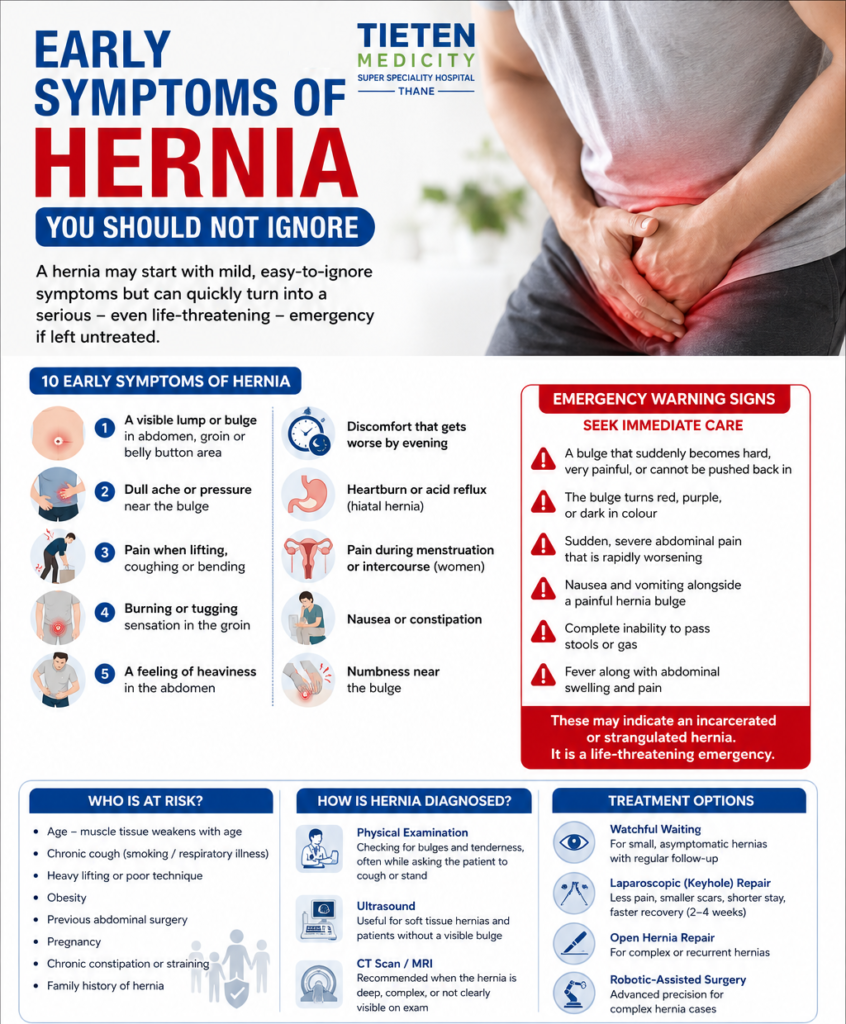
10 Early Symptoms of Hernia You Should Not Ignore
- A Visible Lump or Bulge
The most recognisable early sign of a hernia is a soft lump or bulge under the skin in the abdomen, groin, or belly button area. This bulge is often more noticeable when you stand up, cough, sneeze, or strain — and may disappear when you lie down and relax. Do not ignore this sign, even if it seems small or painless.
- Dull Ache or Pressure Near the Bulge
Many patients describe a nagging, dull ache or a sensation of pressure around the bulge site. This discomfort may come and go, making it easy to dismiss. However, this persistent pressure is your body’s way of signalling that something is not right.
- Pain When Lifting, Coughing, or Bending
If you feel a sharp or worsening pain in your abdomen or groin during physical activity — such as lifting a heavy object, bending forward, or even laughing or coughing — it is a strong indicator of a hernia. These activities increase pressure inside the abdomen and push more tissue through the weak point.
- Burning or Tugging Sensation in the Groin
A burning, pulling, or tugging sensation in the groin area, especially during movement, is one of the first signs of an inguinal hernia. This symptom often appears even before the bulge becomes visible and is frequently overlooked as a muscle strain.
- A Feeling of Heaviness in the Abdomen
Many hernia patients report a persistent feeling of heaviness, fullness, or dragging in the lower abdomen. This sensation tends to worsen towards the end of the day or after long periods of standing or walking.
- Discomfort That Gets Worse by Evening
If you notice that your abdominal or groin discomfort builds up steadily through a busy day and becomes most pronounced by evening, this pattern is a classic warning sign of a hernia. The discomfort usually eases after resting or lying down, but this does not mean the hernia has resolved.
- Heartburn or Acid Reflux (Hiatal Hernia)
Not all hernias cause a visible bulge. If you have a hiatal hernia, part of your stomach has shifted up into your chest cavity. The typical symptoms include frequent heartburn, acid reflux, difficulty swallowing, a feeling of being full very quickly after eating, and persistent burping. These symptoms are often mistaken for gastritis or GERD.
- Pain During Menstruation or Intercourse (Women)
Women are frequently underdiagnosed for hernias because their symptoms differ from those in men. A groin hernia in women may not produce a noticeable bulge. Instead, it may cause pelvic pain, groin discomfort, or pain during menstruation and sexual intercourse. These symptoms are easily confused with gynaecological conditions, which can delay diagnosis significantly.
- Nausea or Constipation
If your hernia has progressed to the point where a section of the intestine is trapped or compressed, you may begin to experience nausea, vomiting, constipation, or an inability to pass gas. These are signs of an advancing hernia and require prompt medical evaluation.
- Numbness Near the Bulge
Numbness or tingling in or around the bulge area may indicate that the hernia is pressing on a nearby nerve or that blood supply to the trapped tissue is becoming restricted. This is a serious warning sign that demands immediate medical attention.
Emergency Warning Signs — Seek Immediate Care
Some hernia symptoms indicate a medical emergency. Go to the emergency department or call Tieten Medicity immediately if you notice any of the following:
- A bulge that suddenly becomes hard, very painful, or cannot be pushed back in
- The bulge turns red, purple, or dark in colour
- Sudden, severe abdominal pain that is rapidly worsening
- Nausea and vomiting alongside a painful hernia bulge
- Complete inability to pass stools or gas
- Fever along with abdominal swelling and pain
These symptoms may indicate an incarcerated or strangulated hernia — where the trapped tissue has been cut off from its blood supply. This is a life-threatening condition requiring emergency surgery.
Who Is at Risk of Developing a Hernia?
Hernias can develop in anyone, but certain factors increase the risk:
- Age — muscle tissue naturally weakens with age
- Chronic cough — from smoking or respiratory illness
- Heavy lifting — especially without proper technique
- Obesity — excess weight puts prolonged pressure on the abdominal wall
- Previous abdominal surgery — scar tissue can be a weak point
- Pregnancy — increases intra-abdominal pressure
- Chronic constipation or straining during bowel movements
- Family history of hernia
Understanding your personal risk factors helps you stay alert to early signs.
How Is a Hernia Diagnosed?
Dr. Pradeep Tripathi and the surgical team at Tieten Medicity Hospital use a thorough approach to hernia diagnosis:
- Physical examination — checking for bulges and tenderness, often while asking the patient to cough or stand
- Ultrasound — useful for soft tissue hernias and for patients without a visible bulge
- CT scan or MRI — recommended when the hernia is deep, complex, or not clearly visible on exam
Accurate diagnosis determines the most appropriate and effective treatment plan for each patient.
Treatment Options at Tieten Medicity Hospital, Thane
Not every hernia requires immediate surgery, but all hernias require a specialist evaluation. Dr. Pradeep Tripathi customises treatment to each patient’s condition, size of hernia, and overall health.
Watchful waiting: For small, asymptomatic hernias — especially umbilical hernias in children — a careful watch-and-wait approach may be recommended with regular follow-up.
Laparoscopic (keyhole) hernia repair: This is the preferred method at Tieten Medicity. Using small incisions and a camera-guided instrument, Dr. Tripathi repairs the hernia with minimal disruption to surrounding tissue. Benefits include:
- Less post-operative pain
- Smaller scars
- Shorter hospital stay
- Faster return to normal activity (typically 2–4 weeks)
Open hernia repair: For complex or recurrent hernias, an open surgical approach may be necessary to ensure a durable, long-lasting repair.
Robotic-assisted surgery: Tieten Medicity is equipped with advanced robotic surgical technology, offering even greater precision for complex hernia cases — one of the few hospitals in Thane to offer this.
Why Choose Dr. Pradeep Tripathi at Tieten Medicity, Thane?
Dr. Pradeep Tripathi is one of India’s most experienced laparoscopic surgeons. His credentials include:
- M.B.B.S – Grant Medical College & Sir J.J. Group of Hospitals, Mumbai
- M.S. (General Surgery) – B.Y.L. Nair Hospital & Topiwala Medical College, Mumbai
- Diploma in Advanced Laparoscopy – GEM Hospital, Coimbatore
- Certificate in Advanced Laparoscopy – Strasbourg, France
- Fellowship in Minimal Access Surgery, Bariatric Surgery, and Robotic Surgery
- 30+ years of clinical experience
- 25,000+ general surgeries and 15,000+ laparoscopic surgeries performed
- Among the first surgeons in India to perform Laparoscopic Whipple’s Surgery and Laparoscopic Ureteric Reimplantation
Tieten Medicity is a 110-bed super specialty hospital on Ghodbunder Road, Thane, with 24×7 emergency and surgical support, modern operation theatres, and a compassionate, patient-first approach to care.
Frequently Asked Questions
Q: Can a hernia go away on its own?
No. Hernias do not heal without medical intervention. They tend to grow larger and more symptomatic over time, and can develop serious complications such as strangulation.
Q: Is hernia surgery safe?
Yes. Laparoscopic hernia repair is a well-established, safe procedure. At Tieten Medicity, Dr. Pradeep Tripathi’s extensive experience and the hospital’s advanced technology ensure excellent outcomes and minimal risk.
Q: How long is recovery after hernia surgery?
With laparoscopic repair, most patients return to light activities within 1–2 weeks and resume full normal activity within 4 weeks.
Q: Can hernias come back after surgery?
Recurrence is rare when surgery is performed by an experienced surgeon using modern mesh-based repair techniques, as practised at Tieten Medicity.
Q: Can women have hernias without a visible bulge?
Yes. Women with inguinal hernias may not have a noticeable bulge and may present only with pelvic or groin pain. An MRI or ultrasound can confirm the diagnosis.
Conclusion
A hernia rarely announces itself loudly. It often begins with subtle signs — a slight bulge, occasional discomfort, or a vague heaviness — that are easy to dismiss. But ignoring these early symptoms can lead to serious complications, including emergency surgery.
If you or a family member in Thane, Mumbai, or the surrounding areas has noticed any of the symptoms described above, do not wait for the situation to worsen. Early diagnosis and timely treatment at Tieten Medicity Hospital with Dr. Pradeep Tripathi can prevent complications and help you recover faster.
