



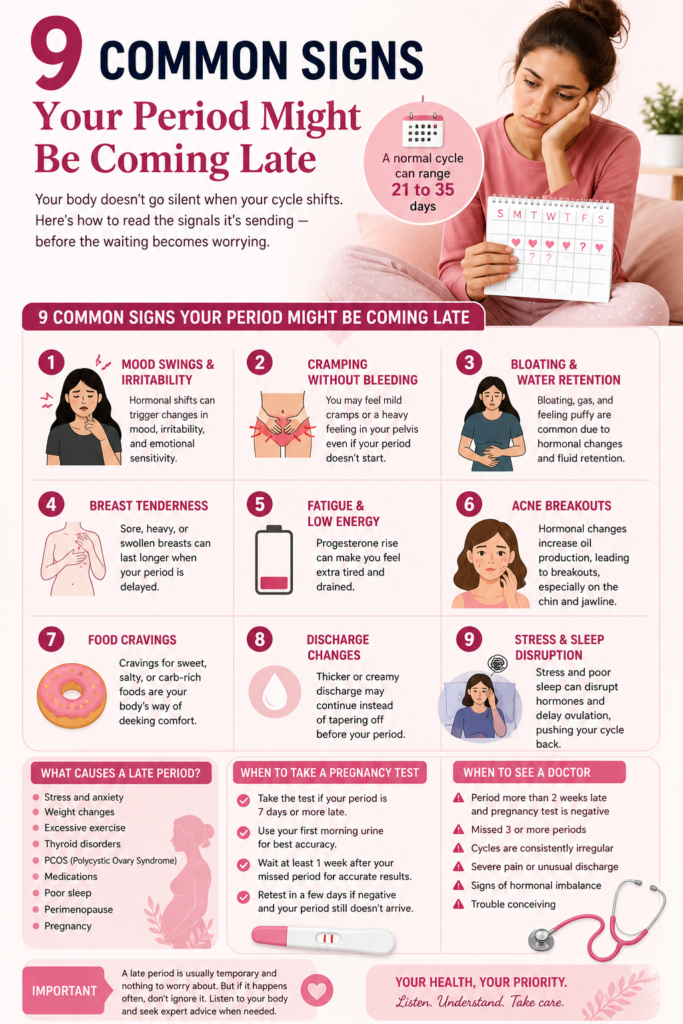
9 Common Signs Your Period Might Be Coming Late
Your body doesn’t go silent when your cycle shifts. Here’s how to read the signals it’s sending — before the waiting becomes worrying.
- Why Periods Run Late
- Mood Swings & Irritability
- Cramping Without Bleeding
- Bloating & Water Retention
- Breast Tenderness
- Fatigue & Low Energy
- Acne Breakouts
- Food Cravings
- Discharge Changes
- Stress & Sleep Disruption
- What Causes a Late Period?
- When to Take a Pregnancy Test
- When to See a Doctor
There is a particular kind of suspense that comes with waiting for your period. You check the calendar. You do the mental math. You feel for familiar cramps that aren’t quite there yet. And somewhere between certainty and confusion, you wonder — is it just running late, or is something else going on?
The truth is, most women will experience a delayed period at some point in their lives, and the vast majority of the time, it has a completely ordinary explanation. But your body is rarely quiet about what’s happening inside it. Even before your period officially shows up — or makes you wait an extra week — it sends out signals you can actually learn to read.
In this guide, we walk through the nine most common signs that your period might be delayed, what those signs really mean at a hormonal level, what tends to push a cycle off schedule, and when it’s worth picking up the phone and calling a doctor.
Aquick note before we begin: A “normal” menstrual cycle can range anywhere from 21 to 35 days. If your period is a day or two later than you expected based on your average cycle, that is not unusual. The signs below become more meaningful when your period is noticeably delayed — typically five days or more past your expected start date.
Mood Swings and Irritability That Won’t Let Up
You know the feeling — one moment you’re fine, the next you’re snapping at a colleague over nothing, or welling up during a commercial that has absolutely no reason to make you cry. Emotional turbulence in the days leading up to your period is one of the most recognized hallmarks of premenstrual syndrome (PMS), and it’s driven by shifting levels of estrogen and progesterone in your body.
During a normal cycle, these hormones build up, peak, and then begin to drop in the days before your period arrives. That drop — particularly in progesterone and serotonin — is what creates the emotional see-saw. The problem is, when your period is late, those hormones may remain elevated longer than they should, which means the mood swings, the irritability, and the heightened emotional sensitivity don’t fade when you expected them to.
So if you’re two or three days past your expected start date and you still feel like you’re running on raw nerves, that’s not a sign something is seriously wrong. It may simply mean your body’s hormonal tide is taking its time to shift — and your period is still on its way.
What makes this sign worth noting: Most people expect PMS to ease up once their period arrives. If the emotional intensity is dragging on well past your expected date, it’s a meaningful signal that your cycle has been extended.
Mild Cramping Without Any Bleeding
Cramps without bleeding can be disorienting. You feel that familiar low ache in your abdomen — the kind that usually signals your period is an hour or two away — but then nothing happens. You check. Still nothing. The cramps continue, sometimes for a day or two, without ever being followed by any flow.
What’s actually happening here is that your uterus is preparing for menstruation. The uterine lining continues to respond to hormonal signals — tightening, shifting, creating that familiar sense of pelvic heaviness — even when the actual bleed is behind schedule. These cramps are sometimes called “phantom cramps” because they mimic the sensation of menstrual onset without delivering on the promise.
They can also occur as a result of mild uterine contractions triggered by hormonal fluctuations, or occasionally as a sign of ovulation if your cycle has been disrupted and your body is attempting to reset itself. Either way, they’re common and, in the absence of severe pain, not a cause for alarm.
It’s worth keeping a simple symptom diary when this happens. Note the character of the pain — is it dull and achy, or sharp? Is it confined to one side? These details become genuinely useful if you end up speaking with a doctor later on.
Bloating and That Uncomfortable Feeling of Water Retention
Feeling puffy, heavy, and like your regular clothes are a size too small — this is one of the most physically uncomfortable signs that your period is approaching or delayed. Premenstrual bloating is so common that most women barely think twice about it, but when it lingers beyond your expected cycle start date, it can start to feel disproportionately miserable.
The cause is rooted in estrogen and progesterone. As estrogen levels rise in the latter half of your cycle, your body begins to retain water in the tissues. Progesterone slows down your digestive system, which compounds the problem by causing gas and general gut sluggishness. The result is that distended, uncomfortable feeling in your abdomen, hips, and sometimes even your fingers and ankles.
When your period is running late, these hormones stay elevated for longer, which means the bloating stays with them. Some women also notice that food feels to sit heavier than usual, or that certain foods they normally tolerate well suddenly cause discomfort. This is your digestive system being slowed by the progesterone that’s supposed to be dropping — and hasn’t yet.
Staying well-hydrated (counterintuitively, drinking more water helps your body release retained fluid), reducing salt intake, and avoiding carbonated drinks can take the edge off while you wait for your cycle to catch up with itself.
Breast Tenderness That Stays Around Longer Than Usual
Sore, heavy, or hypersensitive breasts in the week before your period is a textbook PMS symptom, and for most women, the discomfort begins to ease the moment their period arrives. When your period is delayed, however, breast tenderness can linger long past the point where it normally would — which is one of the reasons it can be such an unsettling experience.
The mechanism is largely driven by progesterone and prolactin, both of which cause the milk ducts and glandular tissue in the breasts to swell slightly in the second half of the menstrual cycle. The breasts may feel fuller, heavier, more sensitive to touch, or even visibly larger. Some women also notice a dull ache that extends into the armpit or the upper arm.
When progesterone should be dropping — signaling the onset of menstruation — but hasn’t yet, these sensations continue. This can make it difficult to distinguish between late-period tenderness and early pregnancy tenderness, since both involve similar hormonal dynamics. If your breast tenderness is accompanied by other early pregnancy symptoms, a home test after a week’s delay is a reasonable next step.
Note on severity: Mild to moderate breast tenderness before and around your period is very common. But if you notice persistent, severe breast pain or a lump that doesn’t resolve with your cycle, that warrants a visit to your doctor regardless of where you are in your cycle.
Fatigue and a General Sense of Running on Empty
There are different kinds of tired. There’s the tired that comes from a poor night’s sleep, the tired from a busy week, and then there’s the very particular, almost sedative tiredness that arrives in the premenstrual phase. It’s the kind of fatigue that makes getting out of bed feel unreasonably difficult, that turns a normal workout into a genuine slog, and that makes you reach for coffee well before noon even if you’re not normally a caffeine-dependent person.
This tiredness is driven primarily by progesterone, which has a naturally sedating effect on the central nervous system. In the luteal phase of your cycle — the two weeks between ovulation and your period — progesterone rises sharply. Your body temperature also rises by about half a degree, which disrupts sleep quality even when you’re logging plenty of hours in bed.
When your period is delayed, this combination of elevated progesterone and disrupted sleep persists longer than your body expected it to. The result is a fatigue that feels disproportionate to your actual activity level, a kind of bone-deep tiredness that doesn’t fully lift after rest. If you’ve been feeling inexplicably exhausted and your period is overdue, this is almost certainly the culprit — and it should ease naturally once your cycle moves forward.
Iron levels can also dip in the days before menstruation begins, contributing to fatigue. If you’re consistently exhausted around your period — delayed or not — it’s worth discussing iron and ferritin levels with your doctor at your next check-up.
Acne Breakouts That Seem to Arrive Without Warning
Just when you thought the skin turbulence of your teenage years was behind you, your menstrual cycle has a way of proving otherwise. Hormonal acne — those deep, tender breakouts that tend to cluster around the chin, jaw, and lower cheeks — is incredibly common in the premenstrual phase, and it’s one of the more visible and frustrating signs that your period may be running late.
The mechanism involves androgens, a class of hormones that includes testosterone. In the days leading up to your period, androgen levels spike relative to estrogen, which triggers the sebaceous glands in your skin to produce more oil. That excess oil, combined with dead skin cells and bacteria, is what leads to the inflammation and breakouts that many women dread each month.
When your period is delayed, the hormonal imbalance that drives this process persists. Estrogen, which helps counteract androgens and keep skin relatively clear, hasn’t yet peaked and dropped in the way it does at the start of a new cycle. So the oil production continues, and the breakouts keep coming.
If you notice that a breakout that should have cleared up by now is still going strong — or a new one has appeared in the spots where you typically get premenstrual acne — this may simply be your skin reflecting the fact that your cycle hasn’t moved on yet.
Increased Appetite and Persistent Food Cravings
If you find yourself standing in front of the refrigerator at 10 PM, eating crackers and cheese after a full dinner, contemplating whether there’s a legitimate reason to have chocolate at breakfast — your body may be telling you something. Premenstrual food cravings are among the most reliably reported symptoms in the entire PMS spectrum, and when your period is late, they often stick around well past the point where they’d normally begin to fade.
The hormonal explanation involves two interconnected mechanisms. First, progesterone increases your basal metabolic rate slightly, meaning your body is genuinely burning more energy than usual — so hunger is partially real, not just psychological. Second, the drop in serotonin that accompanies the premenstrual hormonal shift creates cravings specifically for carbohydrate-rich foods, because carbohydrates help trigger serotonin release. This is why the cravings tend to skew toward sweets, starchy foods, and salty snacks rather than lean protein and salads.
When your period is delayed and these hormonal changes linger, so do the cravings. You may notice yourself eating more than usual across several days, or returning to specific foods repeatedly. While there’s nothing wrong with indulging within reason, significant shifts in your appetite that persist beyond a week past your expected period date — especially if accompanied by other symptoms — are worth taking note of.
Practical note: Keeping complex carbohydrates like oats, sweet potatoes, and whole grains as your go-to craving foods is a sensible strategy during the premenstrual phase. They satisfy the serotonin-seeking urge without the blood sugar spike and crash that comes from processed sweets.
Changes in Vaginal Discharge
Your vaginal discharge changes throughout your menstrual cycle in ways that are actually quite informative, and learning to recognize these changes is one of the most underrated tools for understanding your own body. Around ovulation, discharge tends to become clear and stretchy — often compared in texture to raw egg whites — which signals peak fertility. After ovulation, as progesterone rises, it shifts to a thicker, creamier, more opaque consistency.
In the days immediately before your period, this thicker discharge typically becomes scant and then stops almost entirely, followed by the period itself. When your period is delayed, however, this pattern is extended. Instead of tapering off, you may notice that the thick or creamy post-ovulatory discharge continues well past the point where it would normally have given way to menstrual flow.
Some women also notice a slight yellowish tinge to the discharge in this extended premenstrual phase, which can be alarming but is often simply the result of the discharge spending more time in the vaginal canal before being expelled. However, discharge that is accompanied by a strong or unusual odor, significant color change to green or gray, or itching and burning, should be evaluated by a healthcare provider as it may indicate an infection rather than a hormonal change.
If you’re tracking your cycle using the fertility awareness method, discharge changes are one of the three key signs (alongside basal body temperature and cervical position) that can give you valuable information about where you are in your cycle and why your period may be delayed.
Stress, Poor Sleep, and a Mind That Won’t Switch Off
Of all the signs on this list, this one is somewhat unique — because it’s both a symptom of a delayed period and one of its most common causes. Psychological stress and sleep disruption exist in a bidirectional relationship with your menstrual cycle. Stress can delay your period, and the anxiety of a late period can create more stress, which further unsettles your cycle. It’s a feedback loop that many women know all too well.
The mechanism runs through the hypothalamus — a small but powerful region of the brain that acts as the master regulator of your hormonal system. When you’re under significant physical or emotional stress, your body produces elevated cortisol, which can suppress the release of GnRH (gonadotropin-releasing hormone). GnRH is the signal that triggers the cascade of hormones — FSH and LH — that drive ovulation. When GnRH is suppressed, ovulation may be delayed or disrupted, which pushes your entire cycle back.
The same effect can be triggered by poor sleep. Disrupted sleep raises cortisol levels and reduces melatonin, both of which have a measurable impact on reproductive hormone regulation. Women who work night shifts, have irregular sleep schedules, or are going through periods of significant sleep deprivation often notice their cycles become less predictable.
If you’ve been under unusual stress — a major life event, a work crisis, a period of grief, intense travel, or even a significant change in your daily routine — your late period may be your body’s way of telling you that it took note. This is actually a fairly elegant biological safeguard: under conditions of extreme stress or resource scarcity, reproduction is the body’s last priority.
The reassuring part: Stress-related cycle disruptions are usually temporary. Once the stressor resolves and your sleep improves, your cycle typically returns to its normal pattern within one to two months. That said, chronic stress that disrupts your period repeatedly over several months does warrant attention from a healthcare provider.
What Actually Causes a Late Period?
Understanding the signs of a late period is one thing — understanding why periods run late in the first place is another. The causes range from entirely benign and temporary to conditions that benefit from medical attention. Here are the most common reasons your cycle may have shifted:
Psychological Stress
High cortisol suppresses the hormonal signals that trigger ovulation, pushing your cycle back by days or even weeks.
Weight Changes
Rapid weight gain or loss disrupts the fat-hormone relationship. Adipose tissue plays a meaningful role in estrogen production.
Intense Exercise
High-volume training with low body fat — common in endurance athletes — can suppress ovulation and delay or stop periods entirely.
Thyroid Disorders
Both hypothyroidism and hyperthyroidism affect the regularity and flow of periods, as thyroid hormones interact with reproductive hormones.
PCOS
Polycystic ovary syndrome is one of the leading hormonal causes of irregular and delayed periods in women of reproductive age.
Medications
Hormonal contraceptives, antipsychotics, blood pressure medications, and some antidepressants can all alter cycle timing.
Sleep Disruption
Shift work, jet lag, and chronic poor sleep raise cortisol and lower melatonin in ways that measurably affect reproductive hormones.
Perimenopause
In the years before menopause, cycles often become increasingly irregular. Missed or delayed periods are common during this transition.
Pregnancy
The most well-known cause of a missed period. If there’s any chance of pregnancy, taking a home test is the clearest first step.
When Should You Take a Pregnancy Test?
If your period is seven or more days late and you’ve had unprotected sex in the past month, taking a home pregnancy test is a practical and sensible step. Modern urine-based pregnancy tests detect the hormone hCG (human chorionic gonadotropin), which the body begins producing after a fertilized egg implants in the uterine wall — typically around six to twelve days after conception.
For the most accurate result, take the test first thing in the morning using your first urination of the day, when hCG concentration in your urine is highest. Testing too early — before your period is even due — may give you a false negative, since hCG levels at that stage may still be too low for the test to detect. Waiting until at least the first day of your missed period, or ideally a week after, gives you the most reliable reading.
Beyond the absence of your period itself, the following symptoms may suggest it’s time to reach for a test sooner rather than later:
- ✓Nausea or morning sickness, especially upon waking
- ✓Aversion to foods or smells you normally enjoy
- ✓Light spotting or implantation bleeding (pinkish or brown)
- ✓Breasts that feel unusually heavy or sore
- ✓Needing to urinate more frequently than usual
- ✓Fatigue that feels unlike your usual premenstrual tiredness
A negative result doesn’t necessarily mean you’re not pregnant, particularly if you tested early. If your period still hasn’t arrived several days after a negative test, repeat the test or consult your doctor for a blood test, which can detect pregnancy earlier and with greater sensitivity than a urine test.
When to See a Doctor
Most late periods resolve on their own, and a short delay every now and then is simply part of being human. But there are situations where a late period is your body’s way of asking for more than patience — it’s asking for a professional opinion.
If you’re experiencing any of the following, it’s worth reaching out to a healthcare provider rather than continuing to wait it out:
Speak to a doctor if you notice:
- Your period is more than two weeks late and a home pregnancy test is negative
- You have missed three or more consecutive periods (a condition called secondary amenorrhea)
- Your cycles are consistently irregular — varying by more than ten days from month to month
- You’re experiencing severe pelvic pain, particularly if it’s one-sided and intense
- You have unusual discharge accompanied by itching, burning, or strong odor
- You are noticing signs of hormonal imbalance — significant hair loss, unexpected facial hair growth, or unexplained weight changes
- You are under 16 and have not yet had your first period, or over 45 and experiencing sudden cycle changes
- You have been trying to conceive for more than a year without success (or six months if you are over 35)
A late period in isolation is rarely a medical emergency. But recurring irregularity, particularly when it’s accompanied by other symptoms, can point to underlying conditions — PCOS, thyroid dysfunction, adrenal imbalances, or uterine abnormalities — that are very treatable when caught early. A doctor can order simple blood tests and an ultrasound to rule out these causes and give you a clear picture of what’s happening.
Common Questions
Answers to questions women frequently ask about late or irregular periods.
My test is negative but my period still hasn’t come. What does that mean?
A negative test when your period is late most commonly means one of two things: either you tested too early (hCG levels may not yet be detectable), or your period is delayed for a non-pregnancy reason — stress, hormonal fluctuation, illness, or a disrupted cycle. If the test remains negative after several more days and your period still hasn’t arrived, a visit to your doctor and a blood-based hCG test is the clearest next step.
Can you have PMS symptoms and actually be pregnant?
Yes, and this is one of the more confusing aspects of early pregnancy. The symptoms of early pregnancy — breast tenderness, fatigue, bloating, mood changes, nausea — overlap significantly with premenstrual symptoms because both are driven by elevated progesterone. The primary distinguishing factors are nausea that’s more pronounced, a missed period, and ultimately a positive pregnancy test.
Is it normal for my period to be irregular in my 30s?
Some cycle variation is entirely normal throughout a person’s reproductive years. However, if you notice your periods becoming noticeably more irregular in your 30s — particularly if that’s a change from previously regular cycles — it’s worth having your hormone levels checked. Conditions like PCOS, early perimenopause (which can begin in the mid-to-late 30s for some women), and thyroid changes can all present this way.
How much does stress actually affect your period?
Significantly, particularly during periods of acute or severe stress. Research has shown that psychological stress can delay or suppress ovulation through its effects on cortisol and GnRH. Even short-term stress — a major exam, a bereavement, a change in living situation — can shift your cycle by several days. Chronic stress can cause more prolonged irregularity. The good news is that the effect is typically reversible once the stressor resolves.
Do periods change after coming off hormonal contraception?
Yes, very commonly. After stopping hormonal birth control — the pill, the patch, the hormonal IUD — it can take several months for your natural cycle to re-establish its rhythm. The first few cycles may be irregular, longer, or shorter than your cycles were before you started contraception. This is entirely normal and should stabilize within three to six months for most people.
What are the four phases of the menstrual cycle?
The menstrual cycle is typically divided into four phases: the menstrual phase (when bleeding occurs), the follicular phase (when follicles develop and estrogen rises), ovulation (the release of an egg, triggered by a surge in LH), and the luteal phase (when progesterone rises in preparation for a potential pregnancy, and then falls if fertilization doesn’t occur, triggering the next period).
Your Cycle Is Telling You Something
A late period is, in the majority of cases, a temporary and benign event. But it’s rarely silent. Your body uses the premenstrual phase — delayed or on schedule — to communicate what’s happening hormonally, emotionally, and physically.
Learning to recognize these signs isn’t about anxiety or over-monitoring. It’s about understanding your own rhythms well enough to know when something is within the range of normal, and when it might be worth a conversation with a healthcare provider.
Track your cycles, listen to your body, and don’t hesitate to ask for help when the patterns become persistent. Your reproductive health is worth the attention.
